
The Asian hornet in the Chamonix-Mont-Blanc Valley
The Asian hornet (Vespa velutina) is now present in the Chamonix-Mont-Blanc Valley, and the first nests in the area were identified and destroyed in September 2025. This species, which arrived in France in the early 2000s via the Atlantic coast, is gradually continuing its expansion into the Alps and Haute-Savoie.
Classified as an invasive alien species, the Asian hornet easily adapts to different environments and finds conditions in our landscapes that are favorable to its growth. Its presence disrupts certain natural balances and now poses a threat to human activities.
- 800
- c’est le nombre de nids qui ont été détruits en Haute-Savoie durant l'année 2025
- 4000
- c’est le nombre d'individus que peut compter un seul nid de frelon asiatique en fin d'été
A Species with Multiple Impacts
In the affected areas, its effects are evident on several levels:
- It preys on honeybees, which poses a significant challenge to beekeeping, both economically and in terms of bee health
- It also affects local biodiversity by preying on numerous pollinating insects. A single nest can capture and consume several kilograms of insects over the course of a season
- Its presence in populated areas can also raise questions about coexistence with humans, particularly when nests are located nearby
Observe, Understand, and Take Action
Given its spread, urgent action is needed. Monitoring and control measures have been implemented in the Auvergne-Rhône-Alpes region by the Regional Federation of Health Protection Groups (FRGDS AURA). These measures rely on a surveillance network that enables the detection of nests, the organization of their destruction by certified professionals, and intervention before future queens swarm in the fall.
This early intervention strategy aims to limit and slow the species’ establishment to keep it at an acceptable level. Despite these efforts, the Asian hornet continues to spread, and nest removal remains the primary means of control today.
The Life Cycle of the Asian Hornet
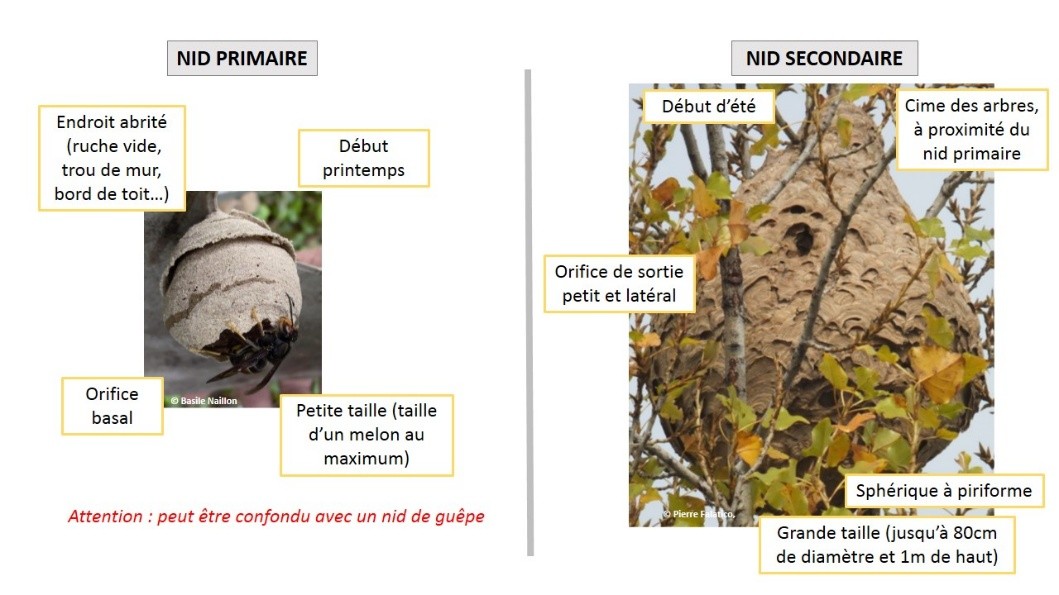
At the end of winter: Founding queens, from the previous year’s colonies, become active as soon as the weather begins to warm. They seek out a sheltered site to build a primary nest, which is often small and located in sheltered areas such as cavities or dense vegetation.
In spring and early summer: the colony gradually grows. The primary nest may then be abandoned in favor of a secondary nest, which is generally larger and located high up in trees. It is in this second nest that the colony reaches its maximum size, producing worker wasps that ensure the group’s feeding and growth.
In late summer and early fall: The nests become highly visible in the treetops as the leaves fall. The colony then produces new future queens and males, whose role is primarily to ensure reproduction. After mating, the young queens leave the nest and seek shelter to spend the winter, while the rest of the colony disappears with the first cold spells.
The effort to control the Asian hornet is part of an annual cycle that combines several complementary actions:
- In the spring: Trapping queen founders in areas colonized the previous year
- In summer: Locating and monitoring nests
- From late summer through fall: Supporting beekeepers and searching for nests
- In the fall: Destruction of nests and targeted trapping around apiaries
Identifying the Asian hornet and its nests
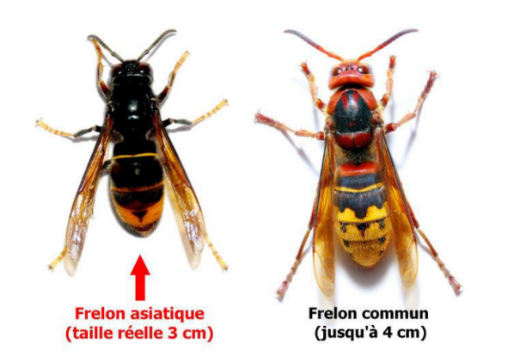
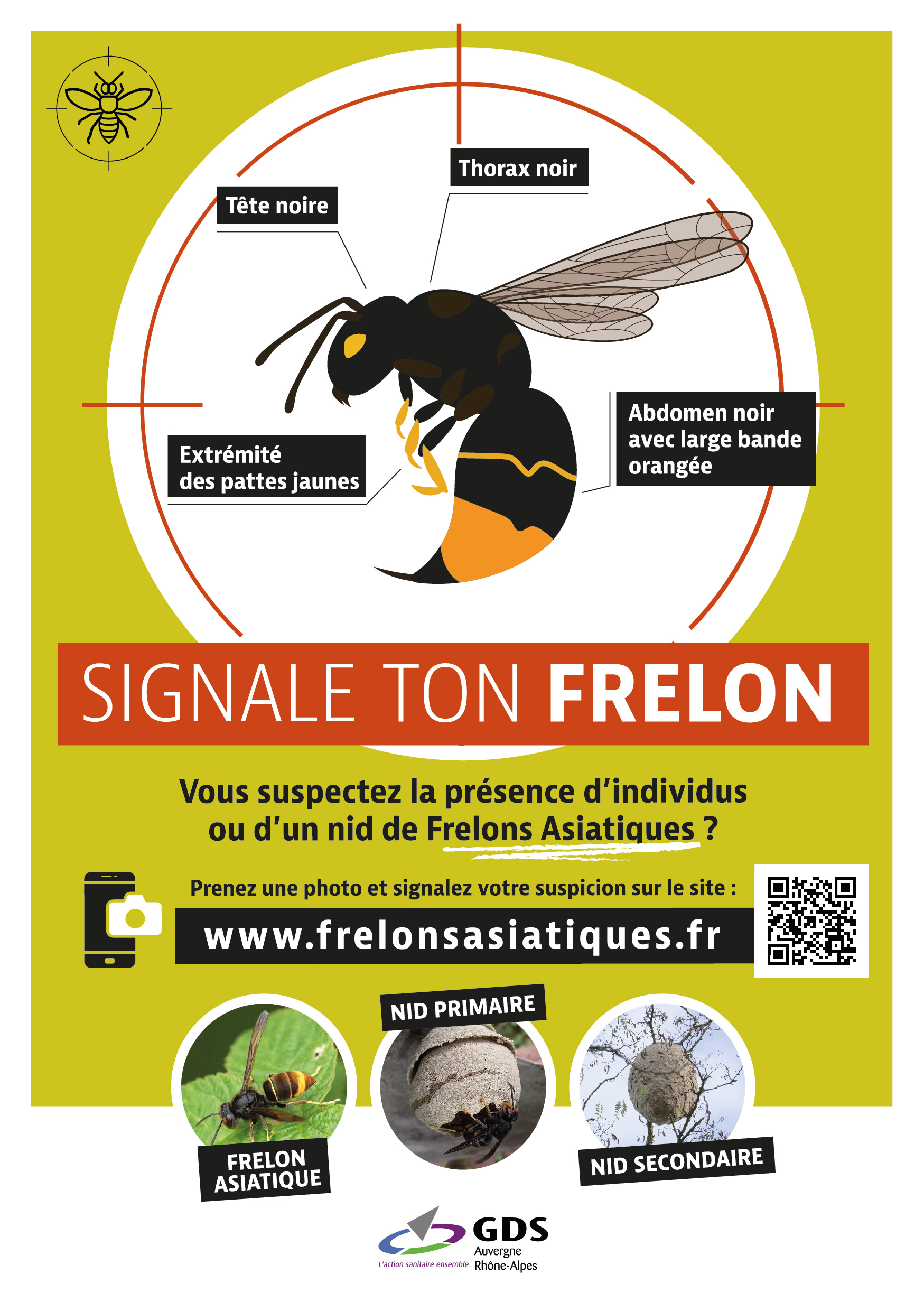
The Asian hornet is slightly smaller than the European hornet. Its body is mostly dark, with a brown to black abdomen marked by an orange ring toward the rear. Its legs have a fairly distinctive feature: they are yellow at the tips, which can help identify it, even in flight.
Differences from the European hornet
The Asian hornet can be confused with the European hornet (Vespa crabro), which is a native species and plays a different and essential ecological role. The European hornet is generally larger, yellower, and less dark in color. It also lives in natural or artificial cavities, often near the ground or in hollow tree trunks.
If in doubt, it is always recommended to report the sighting via the dedicated platform https://www.frelonsasiatiques.fr
Report a nest or an individual
If you suspect a problem, report it directly online via the platform
Simply provide the requested information, including the location and photos that will help identify the species.
Once the nest is confirmed to be that of an Asian hornet, the public health protection group will dispatch a certified professional to remove it as soon as possible.
This system relies on everyone’s vigilance and helps protect public health, bees, and the environment more broadly.
It is important to note that without prior notification, the cost of the removal cannot be covered.
Get Involved and Participate in the Monitoring Network
The monitoring network also relies on the involvement of residents and local stakeholders.
You can become a hornet liaison in your area to help detect and monitor nests. To sign up, visit:
Resources and support tools are also available:
